
The Missouri Disability Empowerment Foundation (MoDE) was created by mothers of children with disabilities who refused to accept a system that left their families behind. In 2016, Missouri moms Robyn Schelp and Molly Myers began speaking publicly about gaps in insurance coverage that made essential therapies inaccessible for their children. What started with a question at a legislative candidate forum quickly grew into a broader conversation about how families of children with disabilities were being overlooked by systems meant to support them.
By 2017, Robyn, Molly, and other parents had created a Facebook page and website to share information and involve others, and began showing up week after week at the Missouri State Capitol. They took their children – 7 in total – to the Capitol on a weekly basis to talk to legislators and educate them on the needs of families raising children with disabilities. As their advocacy grew, so did their visibility. In June 2018, that momentum became official with the founding of the Missouri Disability Empowerment Foundation (MoDE), created by six mothers united by a shared belief: every child deserves access to quality education and meaningful support, regardless of ability.
From a Gap in the System to a Clear Mission
MoDE was created to address two urgent and interconnected problems. First, families of children with disabilities were largely absent from the legislative process. While education policy is shaped by numerous lobbyists representing school administrators, teachers, and districts, there was no consistent advocacy representing families navigating special education. Second, parents were often left to make sense of an overwhelming system on their own — facing denied evaluations, Individualized Education Programs (IEP) not being followed, repeated suspensions related to disability, or unaddressed bullying — without clear information about their rights or access to affordable advocacy.
MoDE stepped into that gap by educating families, training advocates, and helping caregivers access professional support when collaboration with schools wasn’t enough. Just one year after becoming a nonprofit, MoDE reached a major milestone when the Therapy for All bill was signed into law in July 2019, expanding insurance coverage for critical therapies and marking the organization’s first legislative victory.
“After Therapy for All, we narrowed our focus to educational advocacy,” shared Tracey Bloch, MoDE Executive Director. “In 2021, a bill we championed was passed into law, allowing families to record IEP and 504 meetings – a crucial accommodation under Section 504 of the Rehabilitation Act, that helps ensure students with disabilities receive equal access to education through necessary supports. We also passed our Seclusion and Restraint law, which went into effect in 2022 and requires school districts to report incidents to families and the state.”
The work, however, was far from easy. “We didn’t have any paid staff until our sixth year as a nonprofit,” Tracey added. “This work had to be done, even as we balanced other jobs. Being taken seriously was a constant challenge – a group of moms at the Capitol, learning advocacy as we went, while kids had meltdowns during committee hearings and powerful lobbyists tried to intimidate us.”
MoDE’s impact isn’t measured only in bills passed. It’s also seen in classrooms, homes, and the daily lives of families who now feel equipped to advocate for their children.
One mother contacted MoDE when her child was being removed from a general education math class, despite no data supporting the decision. With the organization’s guidance, she filed a formal complaint and pushed for inclusive practices. The result not only kept her child learning alongside peers but also led the school to adopt inclusion strategies that benefited other students as well.
In another case, a student caught in a cycle of disability-related suspensions finally received appropriate behavioral support after MoDE coached the family on securing an Independent Educational Evaluation. The changes were so effective that the district expanded the approach system-wide, ultimately reducing suspension rates and hiring a full-time behavior expert.
One mom shared, “I didn’t know isolation rooms were allowed in schools until my nonverbal son was forced into one during a meltdown. I researched the law and found that MoDE does extensive work on seclusion and restraint in public schools. I reached out to them. We created a plan to schedule an IEP meeting and to begin creating a Behavior Intervention Plan. In that moment, I felt less alone and informed.”
Why MoDE’s Work Matters
MoDE’s vision is both hopeful and honest. The organization dreams of a future where it is no longer needed, where children with disabilities consistently receive the support they deserve, and families are respected as equal partners in their children’s education. That future, however, has not yet arrived. As public systems face growing strain and families encounter increasing barriers, the need for advocacy and empowerment continues to rise.
“What makes this work especially powerful is its ripple effect. When one family is empowered, they don’t keep that knowledge to themselves. They share it. They support others. They become part of a network that strengthens communities from the inside out,” Tracey shared.
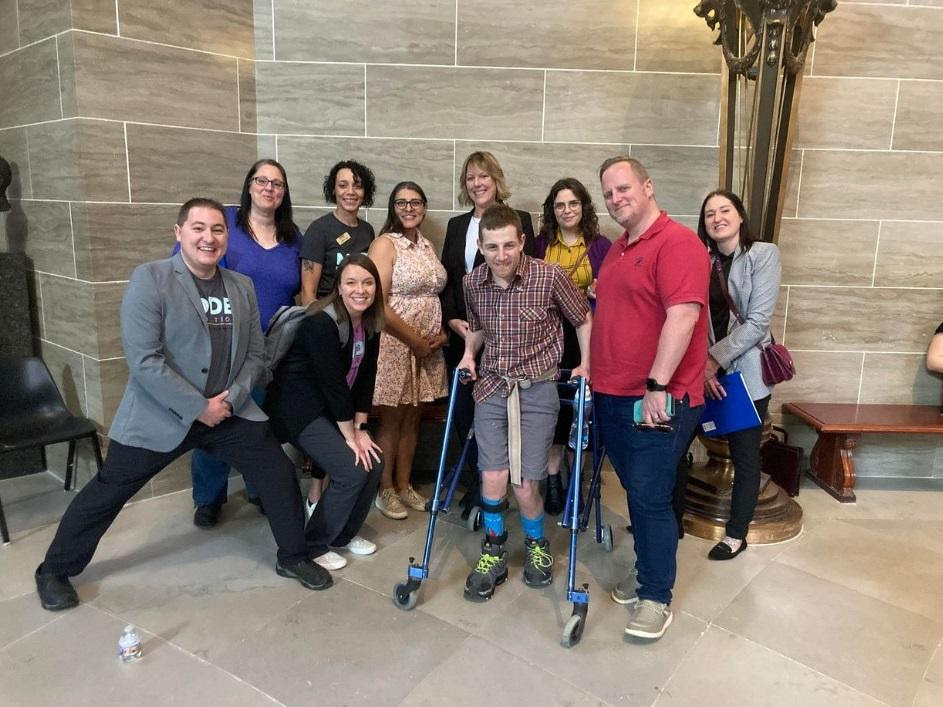
In the photo: MoDE Advocacy Day at the Capitol. Tracey and her husband are in the front left, Jake Wilcott is the self-advocate in the front with the walking aid, and his dad, Josh, is in a red shirt. Elise Moore, their grant writer, is on the far right. This event brought advocates, parents, and self-advocates together. 5 of the people in this picture had never attempted legislative advocacy, and all 5 now actively participate in the legislative process after understanding it and building a relationship with their local elected representative.