
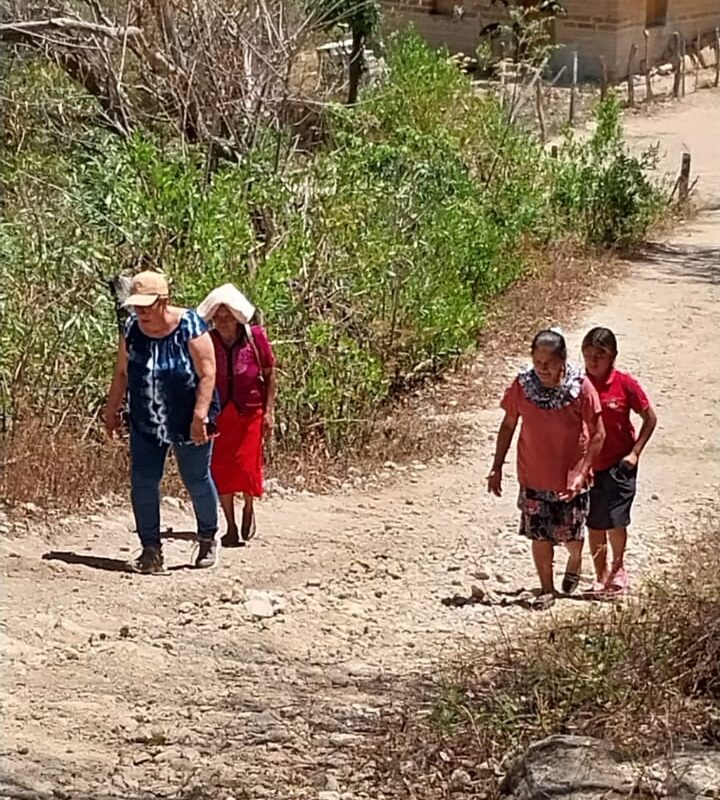
It’s 1 a.m., and in the Honduran mountains it’s pitch black outside. Rafalea grabs her bucket and sets out on a two-hour walk. She moves quickly along the mountain trails, which she knows by heart after walking them hundreds of times. At Mrs. Felix’s house, the situation is similar. She needs water for cooking and for the piglets she raises to earn a living. But when she reaches the spring, she finds only cracked earth where water once flowed. She catches her breath in silence before turning back.
Rafaela’s and Felix’s experiences are not isolated. Across rural Honduras, women are facing increasingly severe water shortages that affect their families, farms, animals, and businesses.
Many participants of Mary’s Pence program in Central America rely on agriculture and livestock for their businesses or household food supply, making access to water essential to their livelihoods.
“Organizations that used to serve women in these areas have halted credit for agricultural activities because farming here is purely subsistence-level, limited by poor soil conditions and a lack of water sources. They say the risk is just too high,” says Mabel, Mary’s Pence Program Lead in Central America.
“In San Marcos de la Sierra, one of the groups we work with bought a water tank because they need it for their business making olive soap. The tank holds 1,100 liters and costs about $37, which is very expensive in these communities. But they decided to buy it because soap-making is their source of income,” says Mabel.
The crisis extends beyond rural communities. In Tegucigalpa, tanker trucks deliver water to some neighborhoods only twice a month. In others, families may go 20 days between water deliveries.
After washing their hands, they collect the used water in a bucket and later use it to flush the toilet. The shortage is also affecting community health and education. Mabel reports an increase in gastrointestinal illnesses and says some schools have considered suspending classes because they do not have water.
El Niño and Climate Change
El Niño has driven more intense heat waves across southern and western Honduras, directly fueling drought conditions — though it isn’t the whole story. The other driver is longer-term climate change. Honduras’s average temperature is rapidly increasing. Together, a warming baseline climate makes each El Niño-driven dry spell more severe.
The stakes are high for women participating in Mary’s Pence programs across Central America, where drought and water scarcity are affecting communities in El Salvador, Guatemala, Honduras, and Nicaragua, not just Honduras. About 70% of participants are involved in agriculture or livestock. When water becomes scarce, women can lose crops, livestock, income.
Continued support
There’s only so much Mary’s Pence can do. But we are listening to women in the region who are increasingly sharing their fears about how a changing climate is affecting their countries and livelihoods. We don’t have the answers, but we will continue to accompany women in the ESPERA program as they navigate the challenges ahead.